Key takeaways
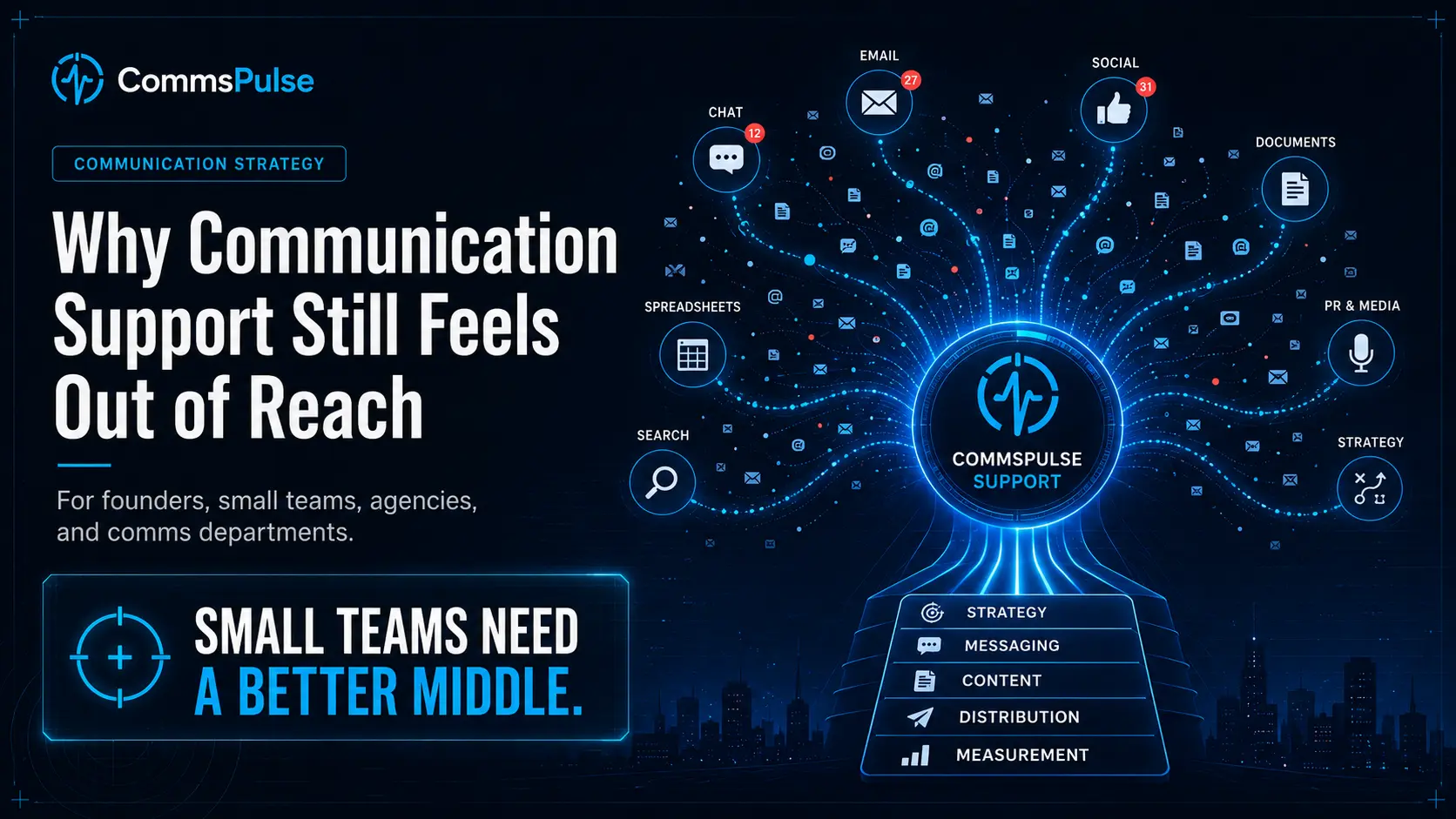
- Small teams face a structural communication gap, not a simple content-volume problem.
- AI has increased output, but it has also made clear positioning, human judgment, and quality control more valuable.
- PR, SEO, social media, founder branding, and content now overlap, yet many teams still buy them separately.
- CommsPulse fills the missing middle with custom-scoped communication support built around one brief, one budget range, and one execution path.
Professional communication support has a strange problem.
Almost every founder, small team, agency, and communications department knows they need better messaging, sharper content, stronger visibility, cleaner social media, and more credible public presence. Yet the support they need often sits just out of reach.
Traditional agencies can feel too expensive, too slow, or too heavy for a specific business problem. Freelancers can help, but managing several specialists creates another job inside the team. AI tools can produce drafts quickly, but speed alone does not solve positioning, tone, risk, judgment, credibility, or channel strategy.
This is the gap CommsPulse was built to address.
The market does not need more random content. It needs better communication decisions, tighter execution, and a simpler way to get expert support without building a full department or signing a large agency retainer.
The real pain points are operational, not just creative
Most communication problems do not begin with writing. They begin before the first word appears.
The team has no clear message. The founder has a strong story but no structure. The agency has client pressure but not enough delivery bandwidth. The marketing manager needs PR, social posts, SEO pages, a campaign message, and a newsletter by the end of the week. The communications team needs a holding statement before a situation grows, but every draft sounds either too defensive or too vague.
That is not a copywriting problem. It is an execution system problem.
Recent industry data points in the same direction. The Content Marketing Institute’s 2025 B2B content marketing research found that many B2B content teams remain small, with 54% of respondents who have dedicated content staff saying their team has only two to five people. The same research found that aligning content with the buyer’s journey remains a challenge for 45% of marketers. Source: Content Marketing Institute
That matters because small teams are not only writing blog posts. They are trying to support sales, visibility, trust, demand generation, leadership presence, employer reputation, launches, events, media outreach, search visibility, newsletters, and social media at the same time.
Ahrefs’ 2025 B2B SEO statistics point to the same pressure. It reported that 40% of B2B marketers identify conversion as their biggest content marketing challenge, 39% cite resource constraints, and 33% struggle with measuring content effectiveness. Source: Ahrefs
Those numbers explain the daily reality for small teams. Content exists, but it does not always convert. People are working, but they do not have enough resources. Reports exist, but the team still cannot clearly prove what works.
The communications workload has outgrown old service boxes
For years, businesses separated communication work into tidy categories.
- PR handled media.
- Marketing handled campaigns.
- SEO handled search.
- Social media handled posts.
- Leadership handled reputation.
- Agencies handled overflow.
That separation no longer reflects how visibility works.
A founder’s LinkedIn post can shape investor trust. A media mention can strengthen AI visibility. A blog post can support search and sales enablement. A crisis statement can become a public reputation signal within minutes. A website service page can influence buyers, search engines, AI answer engines, journalists, and partners at the same time.
PR professionals already feel that overlap. PRSA’s coverage of Muck Rack’s State of PR 2025 report notes that after media relations, PR professionals are focused on thought leadership, measurement and reporting, and content creation. Source: PRSA
This is the new communication reality. PR is no longer only media. Content is no longer only blogging. SEO is no longer only keywords. Social media is no longer only posting. Everything now feeds trust.
Small teams feel this shift first because they cannot solve it by hiring a specialist for every channel.
The opportunity cost is bigger than most teams realize
When communication support feels out of reach, businesses delay work that directly affects credibility and growth.
They delay the press release because nobody knows how to frame the announcement. They postpone the founder’s LinkedIn presence because the first few posts feel uncomfortable. They publish website copy that explains the service poorly. They leave SEO opportunities untouched because nobody has time to build proper briefs. They treat crisis communication as something to handle later, until later arrives under pressure.
These missed opportunities compound quietly.
A founder without a clear public narrative becomes harder to trust. A small team without a content system starts publishing inconsistently. An agency without flexible white-label support turns down work or stretches internal people too thin. A communications department without extra editorial support loses speed during high-stakes moments.
The opportunity is not only traffic. It is trust, readiness, and response speed.
The Edelman-LinkedIn 2025 B2B Thought Leadership Impact Report frames thought leadership as a strategic tool for building trust and opening doors where ads and traditional sales methods often fall short. The report draws on insights from nearly 2,000 global professionals, including visible and hidden decision-makers. Source: Edelman
That is why founder branding, LinkedIn thought leadership, and founder and executive communications should not sit outside the communication system. They now influence how people understand the business itself.
AI made communication faster, but not automatically better
AI has changed how communication work gets produced. That is not in doubt.
Muck Rack’s AI in PR research, covered by Axios, found that three out of four communicators use generative AI at work, based on a survey of 1,013 PR professionals. Axios also reported that only 6% said they had no interest in using the tools. Source: Axios
HubSpot’s AI marketing research shows the same broad adoption, but it also highlights the friction. Its 2025 State of AI data points to data privacy concerns, employee training and time investment, too many tools, integration challenges, and resistance to change as major issues for marketing teams. Source: HubSpot
That combination explains the current market tension. Teams want AI speed, but they do not want generic output, data risk, tool overload, or content that sounds like everyone else.
Google’s own Search Central guidance reinforces the point from the SEO side. Google says its systems prioritize helpful, reliable, people-first content, not content created mainly to manipulate rankings. Its guidance on generative AI content also keeps the focus on quality, usefulness, transparency, and originality. Source: Google Search Central
This is where many businesses make the wrong turn. They treat AI as the strategy. It is not. AI can support speed, structure, research, first drafts, variations, and workflow. It cannot replace judgment about what to say, what not to say, what needs evidence, what could create risk, and what a real audience will believe.
For CommsPulse, AI is not the public product. It is part of the internal workflow. The client does not need to manage prompts, compare tools, clean generic drafts, or wonder whether the output is safe to publish. The client sends the brief. CommsPulse scopes the work, applies human judgment, and delivers communication support that fits the actual problem.
The general issues teams keep facing
Across founders, small teams, agencies, and communications departments, the same issues appear again and again.
1. Unclear messaging
Many businesses describe what they do, but they do not explain why it matters. The website says too much and still leaves the visitor unsure. Social posts sound active but not strategic. Media pitches describe an announcement but not a story.
This is where brand messaging and positioning becomes foundational. Clearer messaging makes every other channel easier.
2. Content without conversion logic
Publishing more does not automatically create trust. Content needs a role. Some pieces should educate. Some should support sales. Some should answer search intent. Some should build founder authority. Some should prepare buyers before a conversation.
That is why content marketing and SEO content services need structure before production begins.
3. PR without a strong angle
A press release is not valuable because it exists. A media pitch is not strong because it is sent to many people. PR works when the story has timing, relevance, credibility, and a clear reason for someone outside the company to care.
CommsPulse supports this through press release writing, media pitch writing, and broader PR and media relations support.
4. Social media without editorial discipline
Many teams treat social media as a daily posting requirement. That creates activity but not always authority. Strong social communication needs a point of view, repeatable themes, a practical content rhythm, and a voice that sounds human.
This is especially true for founders and consultants, where the line between personal authority and business trust is thin.
5. SEO without useful structure
Search has become more demanding. Pages need clear intent, useful headings, internal links, specific examples, strong metadata, and content that genuinely helps the reader. AI search adds another layer: content must be easy for systems to understand, cite, and summarize without becoming thin or generic.
That is why AI visibility services now belong beside SEO, content, PR, and website messaging.
6. Crisis communication prepared too late
Most teams think about crisis communication only when the pressure has already arrived. By then, the wrong sentence can create more damage than silence, and silence can create its own damage.
Every organization does not need a huge crisis manual. Many need practical crisis communications support, holding statements, response principles, escalation language, and approval discipline.
7. Agencies stretched by delivery pressure
Agencies do not only need ideas. They need reliable execution behind the scenes. Campaigns, client content, SEO briefs, PR drafts, LinkedIn posts, newsletters, and website copy can pile up quickly.
Agency white-label support gives agencies a way to protect quality and deadlines without adding permanent headcount too early.
Why visual consistency now matters
Communication credibility does not live only in the words. It also lives in the way ideas appear on the page, in search previews, and across social platforms.
A featured image gives each article a visual entry point. A consistent image system also helps CommsPulse look less like a scattered service website and more like a serious insights platform. When every article uses the same design language, readers begin to recognize the brand before they even read the headline.
For a communications platform, that matters. The article, headline, image, metadata, internal links, and call to action should all work as one system. That is how a blog post becomes more than content. It becomes a trust asset.
How CommsPulse fills the missing middle
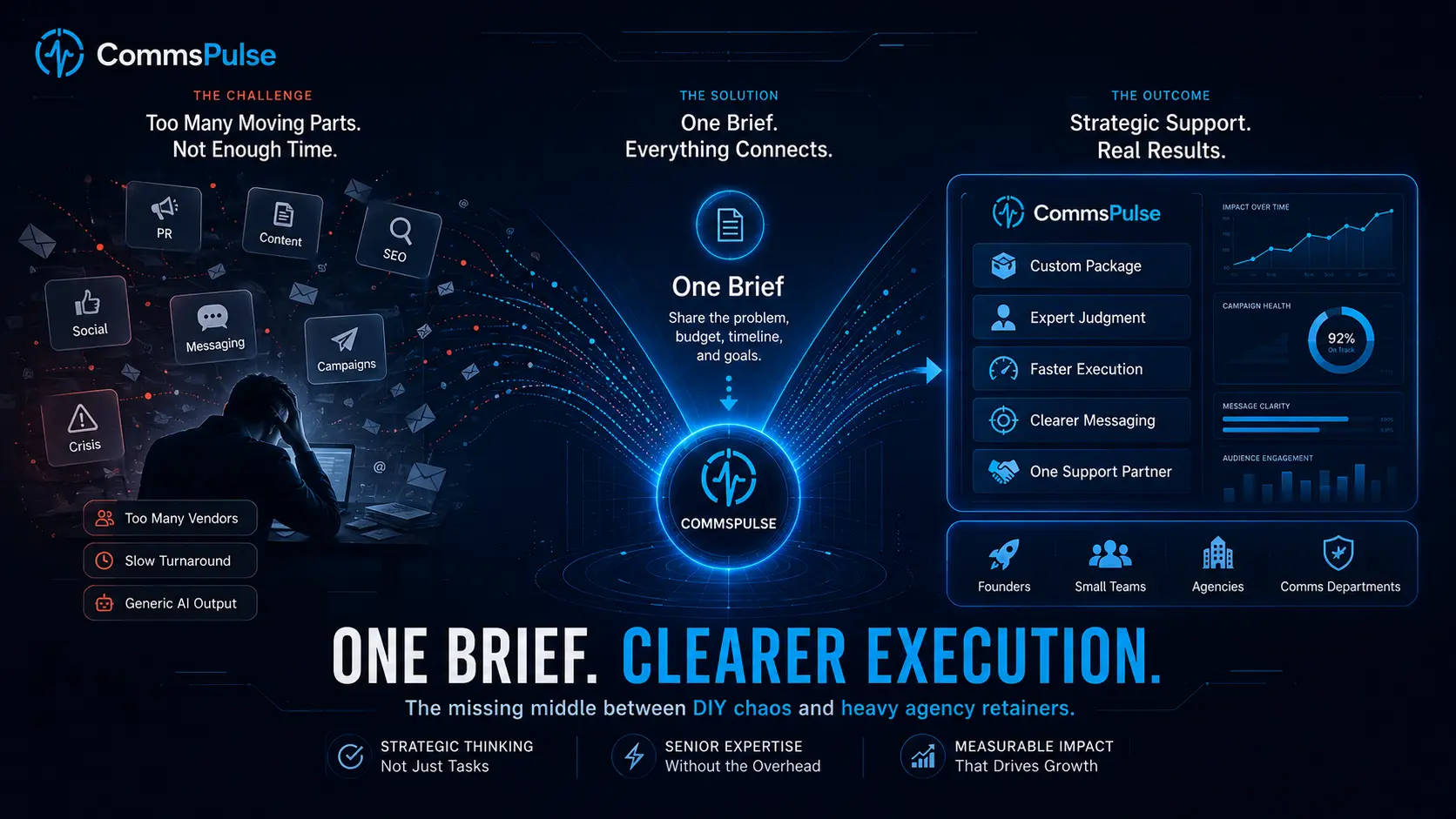
CommsPulse sits between three imperfect options.
- The do-it-yourself approach, which saves money but drains time and creates uneven quality.
- The large agency approach, which may bring capability but often adds cost, process weight, and long cycles.
- The pure AI tool approach, which creates speed but leaves the client responsible for strategy, judgment, editing, risk, and final quality.
CommsPulse fills the middle with a brief-first model.
The client does not buy a public tool, credit pack, or fixed template. The client submits the real problem, the goal, the budget range, the timeline, and the available context. CommsPulse reviews the request and builds a custom package around what actually needs to happen.
That model matters because communication problems rarely fit one narrow category. A founder may ask for LinkedIn posts, but the real problem may be unclear positioning. A company may ask for a press release, but the announcement may need a sharper media angle first. An agency may ask for blog writing, but what they need is a repeatable white-label editorial workflow. A communications department may ask for a statement, but the situation may need internal, external, and leadership messaging together.
One brief allows the work to be scoped as a communication problem, not forced into a pre-made product box.
What CommsPulse can package around one brief
Depending on the request, CommsPulse can build support around:
- PR and media relations
- Press release writing
- Media pitch writing
- Content marketing
- SEO content services
- AI visibility services
- Social media management
- LinkedIn thought leadership
- Founder branding
- Brand messaging and positioning
- Website copywriting
- Email and newsletter marketing
- Crisis communications
- Campaign strategy and execution
- Agency white-label support
The benefit is not only convenience. It is coherence. The message, channel, audience, and execution path can finally work together.
What small teams should do next
The smartest first step is not to publish more content immediately.
Start with one practical audit question:
Once that pain point is clear, the service choice becomes easier.
A founder with a strong track record but weak public presence may need founder branding before social posting. A business with poor search visibility may need SEO service pages before weekly articles. An agency with too much client work may need white-label support before hiring. A team preparing a launch may need campaign messaging, PR, social, and email together.
That is why CommsPulse starts with the brief.
The goal is not to sell every service. The goal is to identify the right communication support for the actual stage, budget, timeline, and business pressure.
Have a communication problem sitting on your desk?
Share the goal, timeline, budget range, and context. CommsPulse will review the request and recommend a practical custom package if the project is a fit.
Start a BriefFAQs
Why do small teams struggle with professional communication support?
Small teams often need PR, content, SEO, social media, messaging, and campaign execution at the same time, but they rarely have enough internal specialists or budget for a full agency retainer.
How does CommsPulse fill the gap?
CommsPulse uses a brief-first model. Clients share the problem, budget, timeline, and goals. CommsPulse then scopes a custom support package across PR, content, SEO, social media, founder branding, campaigns, or agency white-label work.
Is CommsPulse an AI tool platform?
No. CommsPulse may use structured AI-assisted workflows behind the scenes, but the public service is custom communication support shaped by human editorial, strategic, and execution judgment.
Who should use CommsPulse?
CommsPulse is built for founders, small teams, agencies, consultants, and communications departments that need practical support without managing multiple vendors or committing to a large agency cycle.
Research sources used
- Content Marketing Institute: B2B Content Marketing Benchmarks, Budgets, and Trends 2025
- Ahrefs: B2B SEO Statistics for 2025
- PRSA: State of Public Relations, AI and Media Relations
- Axios: PR Professionals Have Tripled AI Use Since 2023
- HubSpot: AI Challenges Marketers Struggle With
- Edelman and LinkedIn: 2025 B2B Thought Leadership Impact Report
- Google Search Central: Creating Helpful, Reliable, People-First Content